Study: 94% of game studios now use AI in production
Published on · Updated on
Vivrato interviewed 101 studio leaders in North America and Europe and found near-universal AI use, though deep pipeline integration remains rare.
Games consultancy Vivrato released the VAIA Report 2026 on Tuesday (Oct. 20), a study finding that 94% of the studio leaders interviewed use artificial intelligence in at least one of nine production stages. The research is based on 101 executives and decision-makers, mostly at studios headquartered in North America and Europe, interviewed between April and September this year.
The figure suggests AI is no longer an isolated experiment and has become part of everyday work in PC and console development. The caveat is depth: the median rating for how deeply AI is embedded across the full pipeline was just 3 out of 10. In other words, the technology is present at the edges of production, not at its core.
How the study was conducted
VAIA stands for Vivrato AI Adoption and is not an online survey. The firm describes it as a structured interview study: 101 confidential conversations, all following the same 44-question guide and covering the same nine production stages. Answers were anonymised and reported only in aggregate, with no individual or company identified.
Of all respondents, 97% said they had used AI in some form during development. The 94% refers to current production use in at least one stage of the pipeline, the sequence that runs from early concept to the live operation of a released game. Vivrato says the research was reviewed by independent games-research analysts.
The sample is relevant but does not represent the entire industry. It covers 101 leaders, with 46 interviews in Europe, 49 in North America and six not broken out by region. Smaller studios, mobile-first companies, Latin America and Asia are marginal or absent from the snapshot.
Where AI shows up in the pipeline
Stage rates were calculated against all 101 interviews, and the number of known answers ranges from 86 to 99 depending on the stage. The top of the list is dominated by technical and general-productivity work, while areas tied to the commercial operation of a live game sit at the bottom.
| Pipeline stage | AI use |
|---|---|
| Code and engineering | 86% |
| General productivity | 83% |
| Concept and pre-production | 79% |
| Design and prototyping | 68% |
| Art, assets and animation | 60% |
| QA and testing | 57% |
| Narrative and worldbuilding | 55% |
| Analytics and player data | 49% |
| LiveOps and monetisation | 37% |
This breakdown helps explain what studios mean by "using AI". Coding assistants, code generation, documentation and automation of repetitive tasks lead the way. Adoption drops when the subject is keeping a game running: tuning economy, moderation and seasonal events, precisely the areas where mistakes are expensive and demand constant human oversight.
Wide use, shallow integration
Respondents rated from 0 to 10 how deeply AI is built into their entire pipeline. The result is a picture of shallow adoption: 52% placed themselves at 3 or lower. Of those, 17% sat in the 0-1 band and 35% in the 2-3 band. Another 32% were in the middle, between 4 and 6.
At the top of the scale, the group is small: 9% rated themselves 7 to 8 and only 7% rated 9 to 10. In practice, fewer than one in six respondents considers their studio mature in applying the technology across the whole process. The depth score was based on 100 of the 101 interviews.

Europe ahead, North America behind
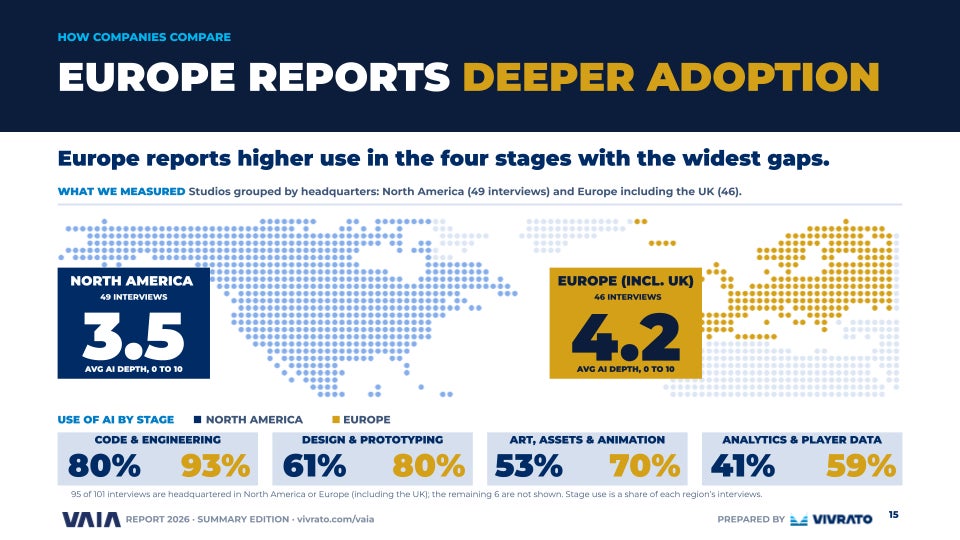
There is also a regional gap. Leaders at European studios, including the UK, reported an average integration depth of 4.2 out of 10, against 3.5 out of 10 in North America. The bases were 46 interviews in Europe and 49 in North America, with six cases not separated by the researchers.
The European edge is not structural, but it stands out at a moment of regulatory pressure. The European Union is advancing rules on AI transparency and copyright, which could both encourage better-documented practices and add caution inside studios.
Why the definition of AI matters
The report insists on separating "AI" from "generative AI". Each interview covered six distinct categories: generative AI (language models, image and audio generation), classical machine learning for prediction, classification and clustering, rules-based automation, retrieval-augmented (RAG) systems, fine-tuned or custom-trained models, and autonomous AI workflows, or agentic systems.
"This year, public discourse and definitions about AI in games usually default to generative AI: chatbots, image generation and synthetic voices. However, we know that studios use AI in a variety of ways, from machine learning that predicts player churn to rules-based automation in testing, with very different results. That makes now the right moment to set a clear baseline, so we created VAIA, a dedicated research vertical within Vivrato to track and measure what is actually happening behind closed doors."
The distinction matters because 94% does not mean nine in ten studios use image or text generators. Many reported cases are simple automations, scripts and predictive models that existed before the chatbot boom. That changes the debate over the replacement of artists, voice actors and writers.
What the number does not say
The methodology itself limits conclusions. The sample is one of convenience, made up of leaders willing to speak under confidentiality, not a random selection of the whole industry. Vivrato also sells paid reports derived from the study: a studio report with peer benchmarking and an enterprise report with up to four additional interviews and an executive readout.
On top of that, the data is self-reported. A studio may count anything as "AI use", from a coding assistant to a proprietary asset-generation pipeline. Without an external audit of processes, comparisons between companies should be read with caution, as a thermometer of perception rather than a technical X-ray.
Context: AI at the centre of the debate
The release arrives in a year of tension between studios and players. Uses of generative AI in voice acting, concept art and localisation have drawn negative reactions from players and professionals. At Amazon, an AI-made anime dub was rolled back after fan pressure, an episode that shows the scale of reputational risk.
Development tools are also moving fast. Unity launched an official plugin for Claude Code, bringing coding assistants closer to the workflow of game creators. It is in this space, between productivity and code automation, that the report finds its highest adoption: 86% in engineering.
For more news on the games industry and changes in game development, visit the games section of O Santuário Geek. The full VAIA 2026 report is available on Vivrato's official website, and the press release with the data was published on Games Press.
Suggested and related articles
DeepMind's Gemini agents beat Minecraft with no human help

80s Trend on ChatGPT Takes Over Instagram: How to Transform Your Photos With AI for a Perfect Retro Look

Unity launches official plugin for Claude Code: tighter AI integration, fewer errors, token savings

Ragnarok Online PLUS+ Opens CBT in South Korea

Football Manager 27 Gets 5-Day Free Trial