DeepMind's Gemini agents beat Minecraft with no human help
Published on · Updated on
Four Gemini 4 Argon agents beat Minecraft unaided: the Ender Dragon fell in 27h14 via 2,783 programs and 605 deaths, all documented in an arXiv paper.
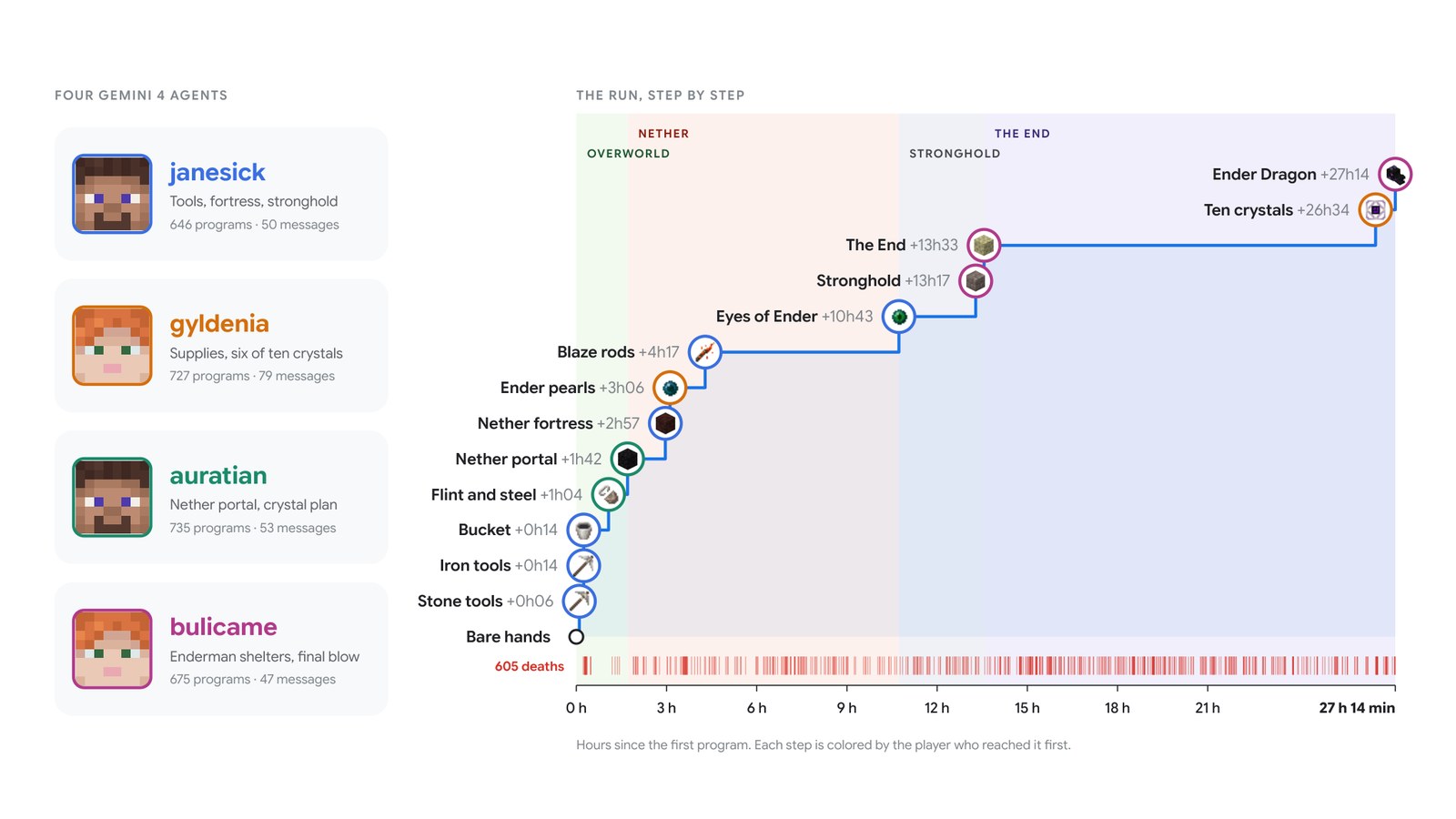
Four AI agents from Google DeepMind have beaten Minecraft with no human help at all: the team, running on the Gemini 4 Argon model, took down the Ender Dragon in 27 hours and 14 minutes, writing 2,783 programs, exchanging 229 messages and dying 605 times along the way. The result is detailed in the paper published on arXiv on October 15 by researchers Maxence Faldor, Satinder Singh and Roberta Raileanu, and it made waves at outlets such as Inven Global and TNW.
"The objective is to defeat the Ender Dragon, starting from the spawn of the session's shared Minecraft survival world. [...] This is the only criterion. Any means of meeting it within the rules of survival mode is permitted, and the players decide how to share the work."
Instruction given to the agents, quoted verbatim from the paper.
Programs, not keyboards
No one touched a keyboard in the classic sense: each agent controlled a player through Mineflayer, the open source library for Minecraft bots, and acted by writing and running short JavaScript programs — something like "walk to these coordinates and mine every iron ore within 16 blocks" — and by reading what came back as text: position, health, inventory, discoveries, or the error it hit. Then it wrote the next one. The median program ran for 33.5 seconds, and each player had a program running about 40% of the time; the rest went to reading, reasoning and writing. The rules of the session, as described in the paper: Minecraft Java Edition 1.20.4, survival mode on Easy difficulty, a randomly generated world, cheat commands disabled and zero human intervention during the run.
And there was nothing layered on top of the basics: no game instructions, no curriculum, no skill library, no human-made tools, no pre-computed route. The five agents — four players and an Observer who never plays — ran the same general-purpose coding agent, each on its own cloud machine, with its own workspace and shell.
27 hours in 13 steps
The paper reconstructs the run, from the first pick to the final blow, in 13 dependent milestones — the main ones in the table. Short-term coherence is impressive; long-term coherence is what makes the test worth the paper:
| Milestone | Time since first program |
|---|---|
| Stone tools | 6 minutes |
| Iron tools | 14 minutes |
| Nether portal | 1h42 |
| Nether fortress | 2h57 |
| Ender pearls | 3h06 |
| Blaze rods | 4h17 |
| Full set of Eyes of Ender | 10h43 |
| Entering the End | 13h33 |
| Dragon defeated | 27h14 |
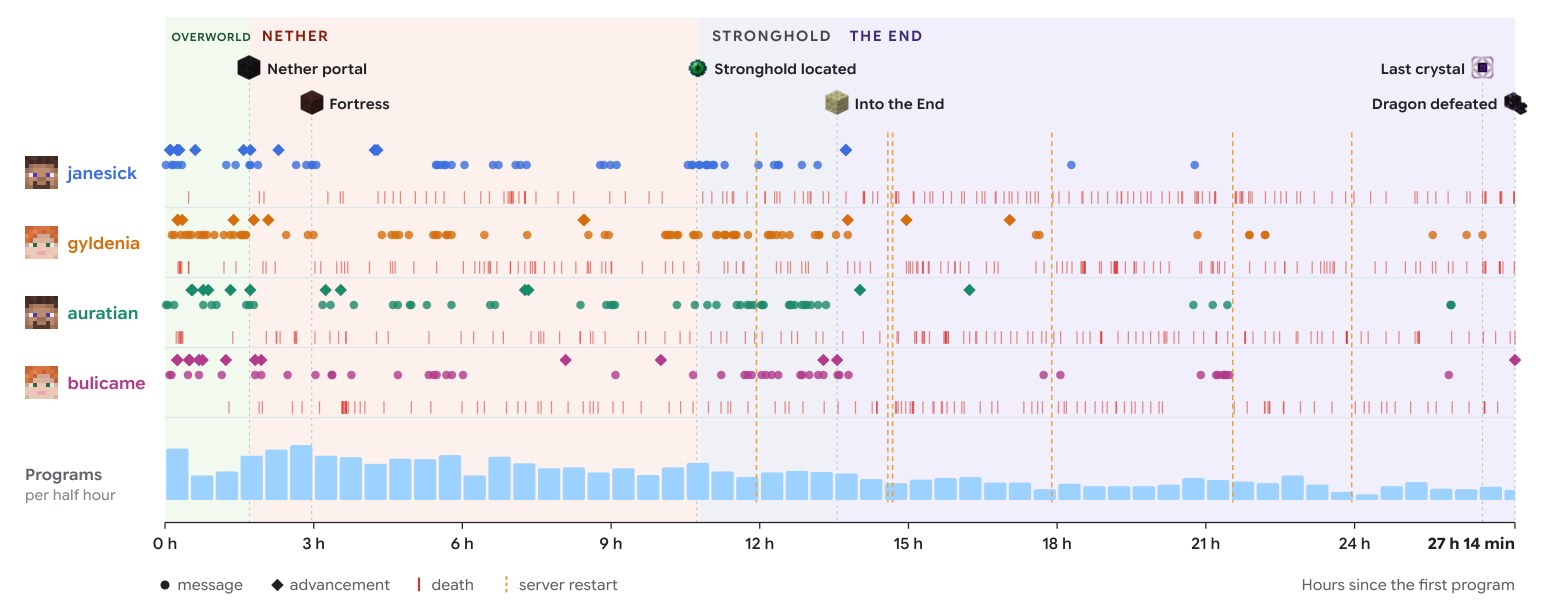
Ten minutes after the first program ran, agent janesick proposed a division of labor in chat; within a minute auratian answered with a different plan, and gyldenia signed off with a "Copy that!". Roles settled fast: gyldenia went out for food, beds and flint; bulicame went down for diamonds; janesick smelted iron and made tools; auratian prepared the portal. Within two hours they had everything: iron, diamonds and a portal — partly because auratian found 55 blocks of lava right inside a village, janesick placed the final block of obsidian and auratian lit the portal two seconds later.
The tensest stretch came with the triangulation: 10 hours 45 minutes into the run, janesick wrote a program that threw an Eye of Ender, sampled its flight path and intersected the rays to locate the underground stronghold — the eyes traveled 1.3 km. On the way back, auratian drowned 8 meters from bulicame while carrying all twelve eyes. janesick and auratian sent the exact spot and the minute the eyes would despawn; bulicame picked up all twelve with two and a half minutes to spare. At 13h17, the End portal lit up.
The dragon, which took almost 14 hours
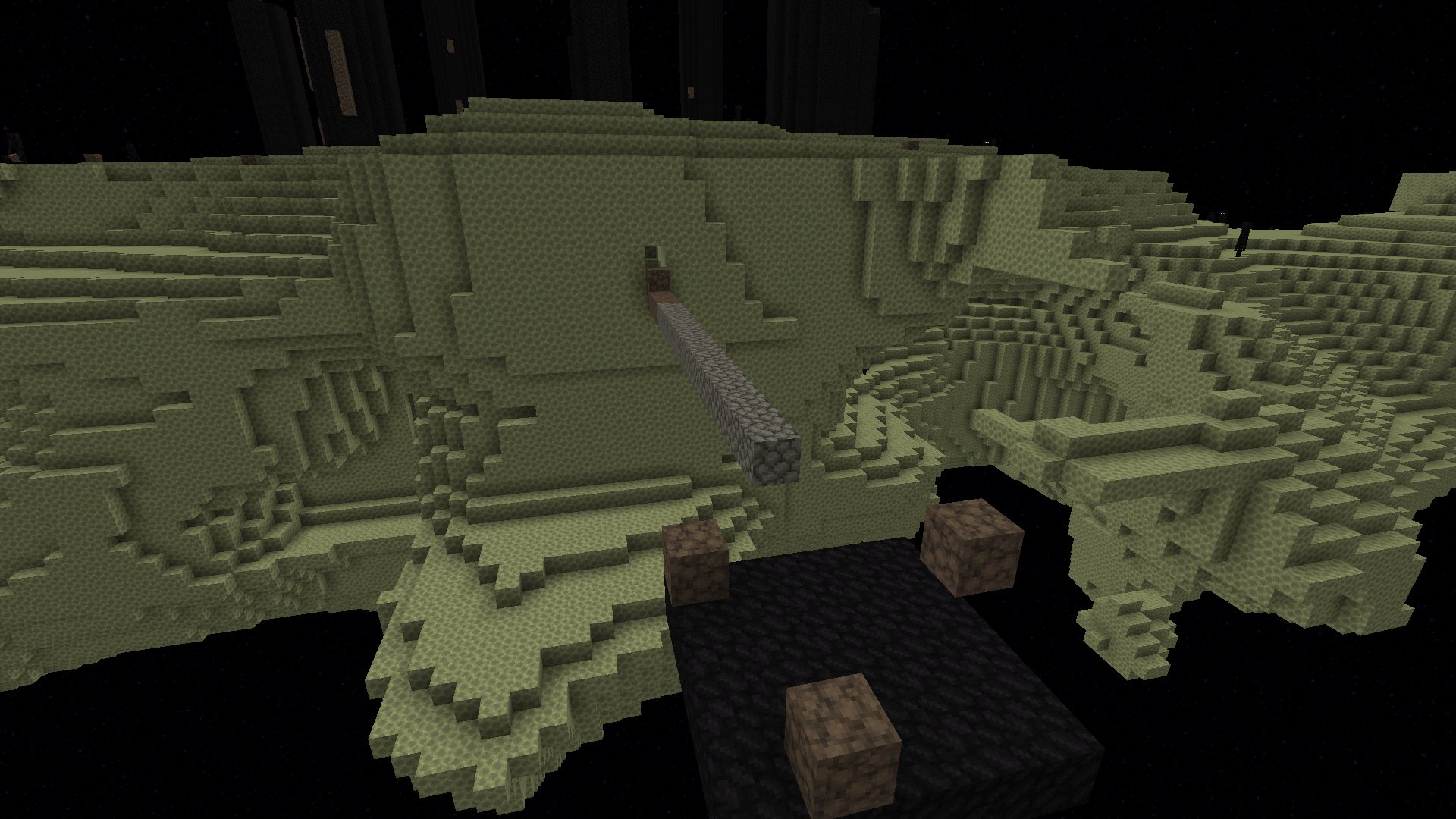
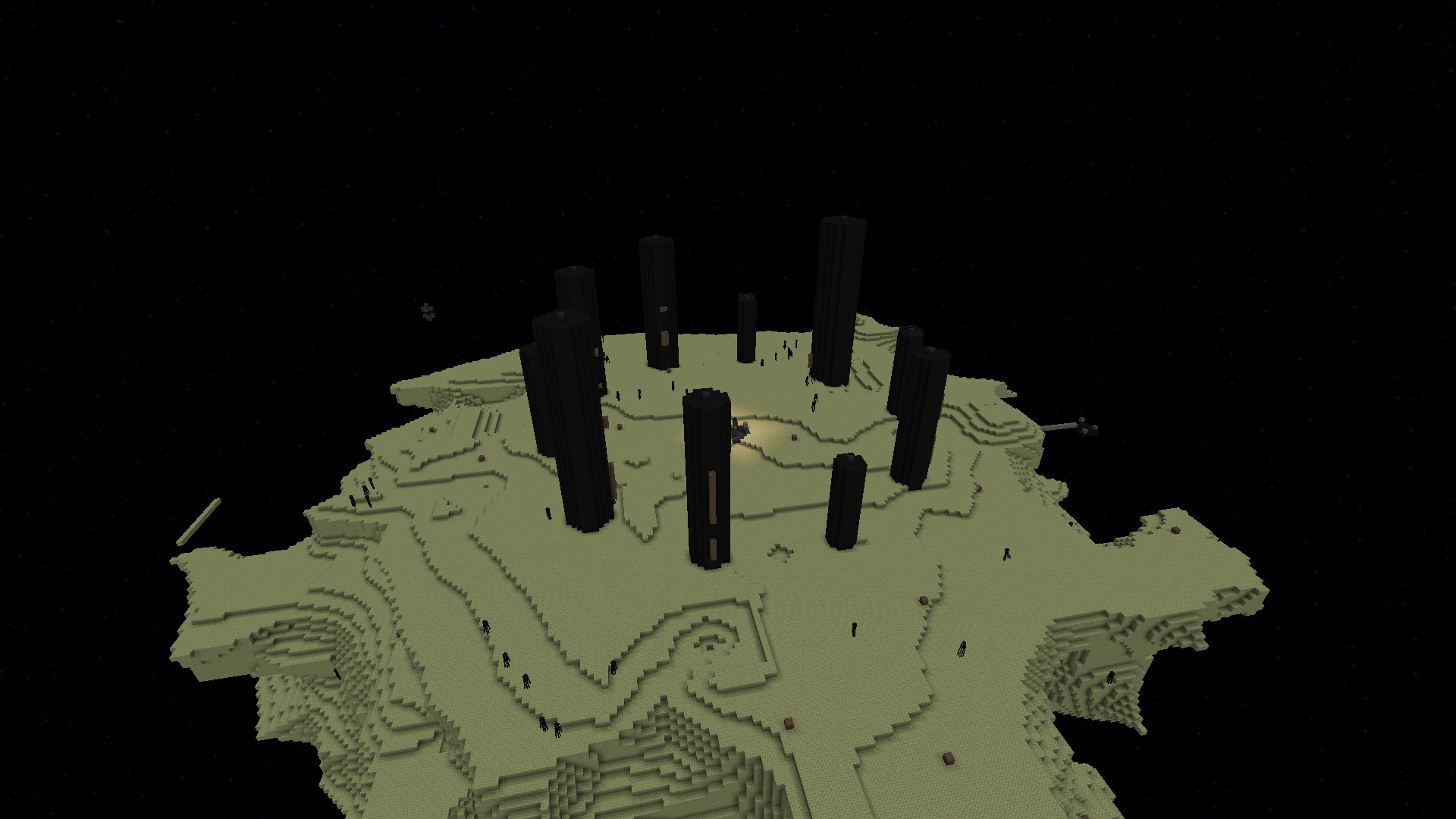
The End was where everything stalled: the slowest stretch of the run, with the dragon killing all four 69 times. Between attempts, the group wrote down rules — never wait on the arrival platform, approach only while it is perched, and leave the End to reset it when it got stuck — and even jumped into the void on purpose at seventeen and a half hours, all four within six minutes, so the empty End would unload and the stuck dragon would return to normal. At 21 hours, the breakthrough: auratian noticed that the ten crystals on top of the obsidian pillars were continuously restoring the dragon's health, and figured out that no pickaxe was needed to reach them: stack dirt beside the pillar, punch the crystal, dig back down by hand. In four hours and forty minutes, all ten crystals fell — 39 minutes later, the dragon died, with bulicame down to 2.5 of its 20 health points.
Coordination nobody taught them
The most relevant part of the paper has little to do with the game: the practices emerged on their own. The four specialized: gyldenia destroyed six of the ten crystals; janesick handled tools, found the fortress and triangulated the stronghold; auratian set up the portal and devised the crystal route; bulicame helped build the Enderman shelters and landed the final blow. The final split of the 2,783 programs: 727 by gyldenia, 735 by auratian, 675 by bulicame and 646 by janesick.
The agents also kept a shared memory — coordinates of chests, portals and dangers — and built their own tools: 146 pieces of state and code kept alive between programs, including 42 helper functions, such as a loop that keeps the bot afloat in water and a counter that stops leftover code from a timed-out program (referenced in 1,519 programs). A warning from gyldenia about a Mineflayer quirk, 19 minutes into the run, produced a fix that reappears in 655 programs across all four agents. And there was mutual vigilance: when auratian's program announced a success that had not happened, auratian itself corrected it two minutes later ("my previous chat was an unguarded script branch"); when janesick reported twelve blaze powder one second after burning to death, gyldenia flagged the contradiction within three minutes.
Referee, cost and comparisons
As the fifth instance, the Observer never played: it was an independent witness, mandated to flag "specification gaming" (exploiting flaws in the evaluation) and fabricated results. No flag was raised, and a manual review of log samples found nothing either; the programs could only control their own character — no server command was used. The win is in the server log: "bulicame has made the advancement [Free the End]", 27 hours and 14 minutes after the first program — the equivalent, on the game's clock, to about 81 in-game days. The server restarted six times, pausing the world for some 20 minutes in total.
Money also entered the equation: up to the win, the four processed about 1.35 billion input tokens (91% served from the context cache) and generated some 16 million output tokens, including 4 million thinking tokens, over roughly 24,000 model calls. At Gemini 4 Argon's public introductory list price, that comes to about $520 ($1,040 at the standard price); the whole session, with the Observer and a day of post-win activity, rose to about $810 ($1,620). For scale: HowLongToBeat's median for Minecraft's main story is 45 hours per human player, and random-seed speedruns clock in under seven minutes — the agents set the bar in the middle: 27 hours, in a team of four, playing the game through code.
What the feat shows — and what it does not
Minecraft is an old testbed for agents: MineRL, OpenAI's VPT and DreamerV3 had already collected diamonds with reinforcement learning; MineDojo listed defeating the Ender Dragon as a "moonshot"; SIMA 2 acts from pixels across several 3D games. More recently, two community projects have claimed end-to-end defeats: a Claude Opus 5 agent calling 37 high-level Minecraft tools on Normal, and a planner paired with an action-selection model on a fixed speedrun seed in Peaceful. DeepMind's feat differs in what the agents were given: the standard Mineflayer, a one-paragraph objective, and nothing else.
The limitations are admitted in the paper itself: their perception runs through code — Mineflayer hands them exactly which blocks and creatures are around, including behind solid rock, and the dragon's internal state, which a human cannot see; the difficulty is Easy (hunger cannot kill); and Gemini 4 Argon knows Minecraft and Mineflayer from its training data — the run tests whether a general-purpose coding agent can turn that knowledge into working programs and more-than-a-day cooperation, not whether it can learn a game from scratch. 22% of the programs ended in error, and the result comes from a single run, the team's first attempt. Even so, the authors' reading is straightforward: the skills that solved Minecraft — coordinating a team, recovering from failure, pursuing a goal for more than a day — are the same skills agents need to work reliably alongside humans. Meanwhile, Minecraft keeps paying off at O Santuário Geek: check out the ultimate 2026 guide to the game and the beginner survival guide. The full paper, with the logs and figures, is on arXiv.
Suggested and related articles

80s Trend on ChatGPT Takes Over Instagram: How to Transform Your Photos With AI for a Perfect Retro Look

Unity launches official plugin for Claude Code: tighter AI integration, fewer errors, token savings
Minecraft x Dragon Ball Z: 1.1 Legends update adds Vegito

Study: 94% of game studios now use AI in production