Epic Claims Faster Launcher, but Valve Had a Patch First
Published on · Updated on
Epic released its new Epic Games Launcher in Preview and pitched it as faster than Steam; Valve had sped up its client a day earlier, on October 13.
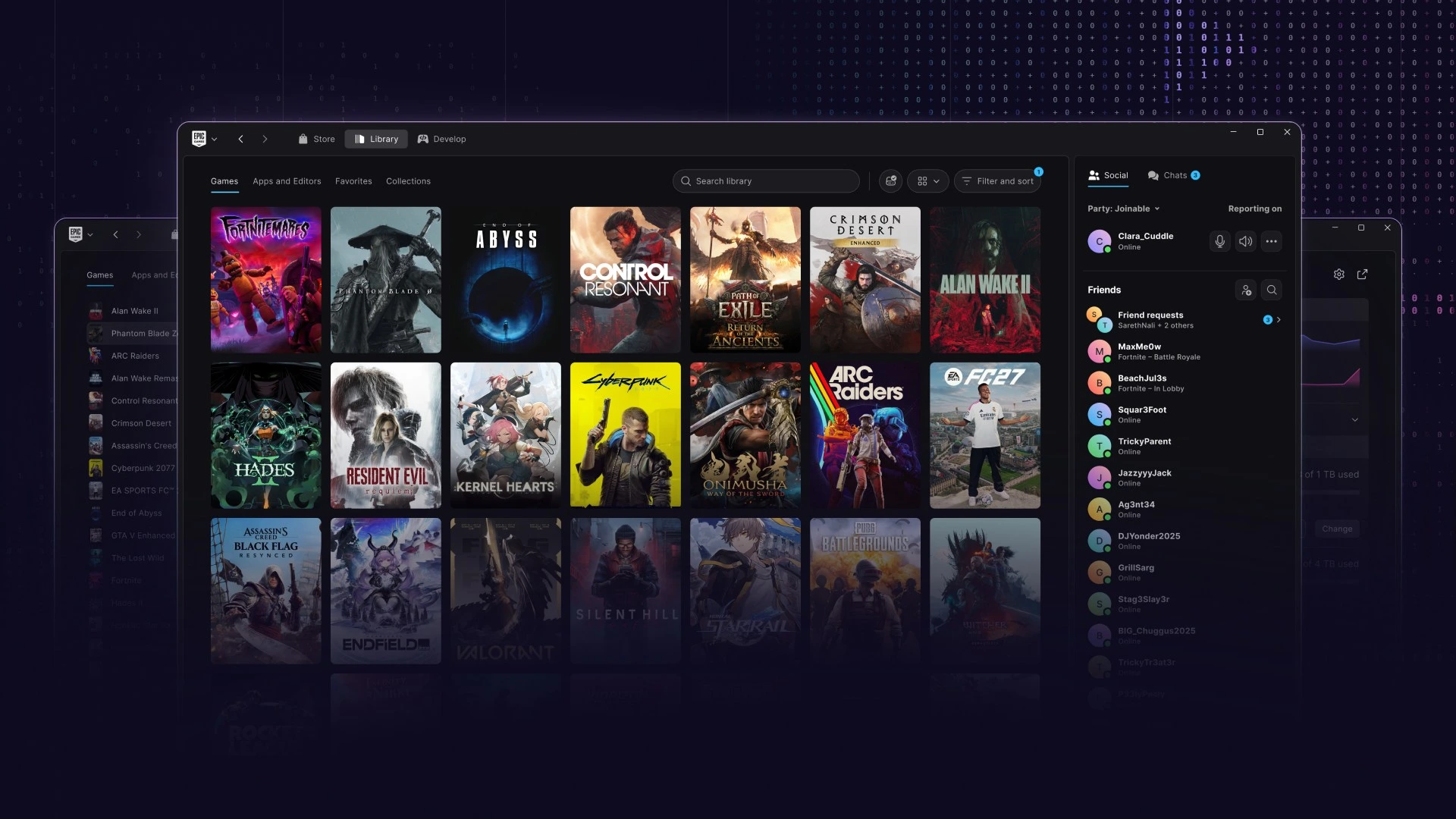
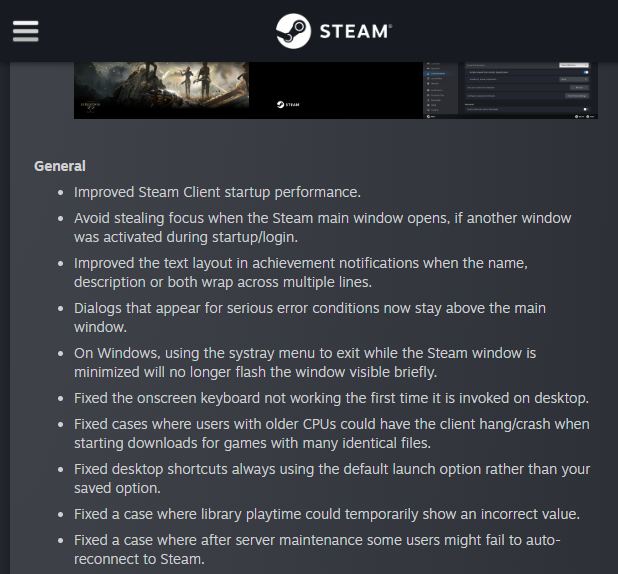
Epic Games released on October 14, 2026 a complete rebuild of its launcher — built with "vibe coding," that is, with code generated by artificial intelligence — and pitched it as faster than Steam. The new Epic Games Launcher arrived in Preview version for Windows, macOS and, for the first time, Linux. The timing problem is obvious: Valve had published a Steam client update a day earlier, on October 13, and the first line of the release notes, in the "General" section, read exactly "Improved Steam Client startup performance" — an improvement in startup performance. The two companies began fighting over seconds at the very moment Epic was trying to turn speed into a marketing argument.
What Epic Put in Preview
The announcement was made on the official Epic Games Store blog, in a text that opens with a phrase that became a joke and a controversy in developer forums: "Programming is hard." The company explains that, instead of rewriting the client by hand, it delegated code creation to AI. The tone is mocking, and Epic itself acknowledges the limitations of the first version: "This first release is light on features. Think of it as a speedboat, not a yacht."
"Programming is hard. So instead of doing that, we 'vibe coded' a new Epic Games Launcher that is much faster and more responsive than the current one, and has a new look."
In terms of features, what arrived is a client rebuilt from scratch: a dedicated page for each game in the library, with status, activity and launch controls; collections alongside the library; switching between grid and list views; a customizable top bar; search and filters that respond as you type; and a download monitor that shows read and write speeds and separates active, queued, scheduled and failed downloads. Voice chat and groups work across Fortnite, Epic Games Store and the Epic app. Native Linux support is new: previous versions relied on compatibility layers.
Epic also recommends caution: "If you're a competitive player or a developer working on an active project, we recommend using the current launcher during Preview." To bring Fortnite to Linux, the company says it is rebuilding Easy Anti-Cheat (EAC) in partnership with distribution maintainers.
The Numbers Epic Released
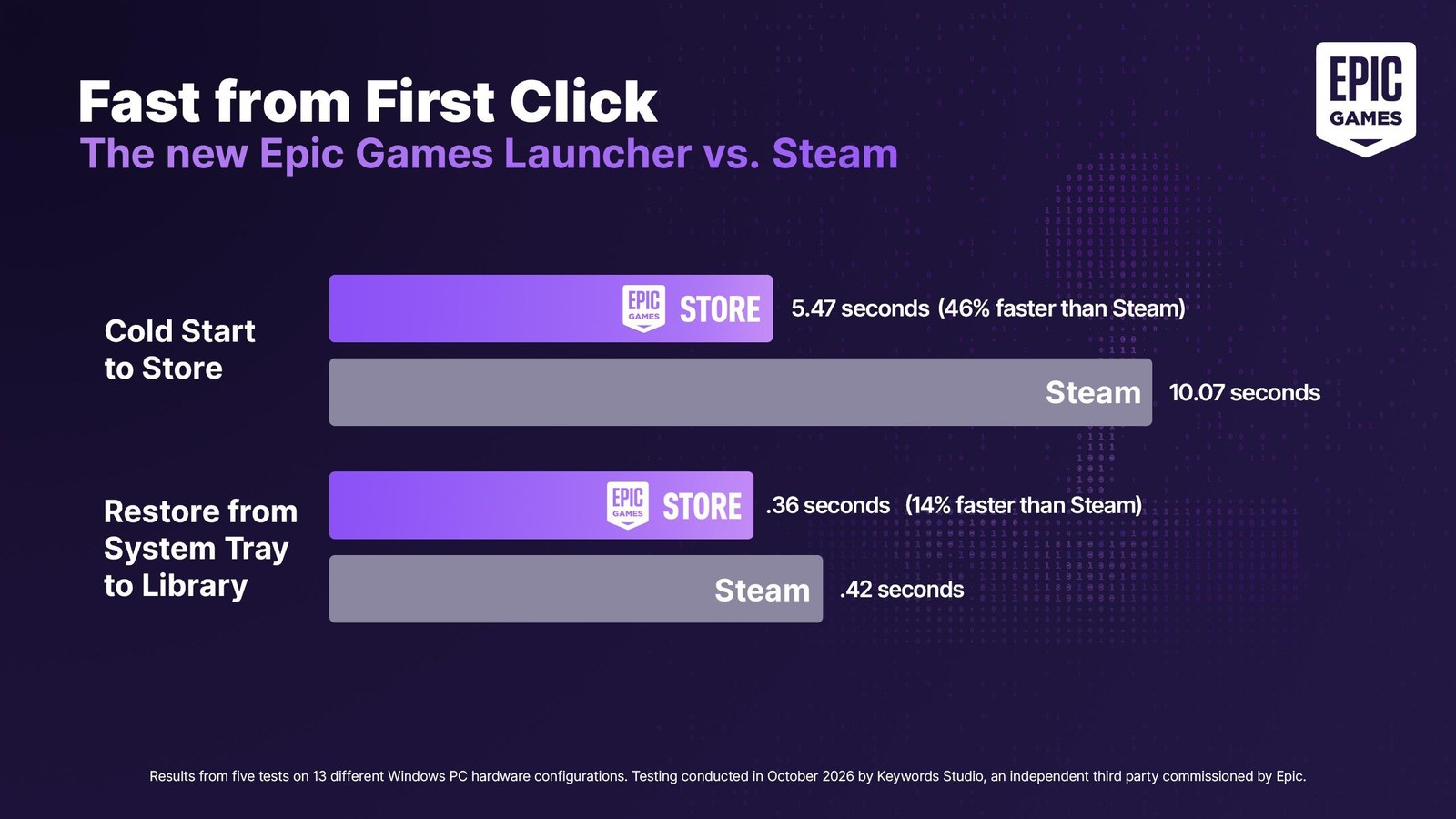
On the Preview page and on social media, Epic was direct. The official post on X says: "We vibe coded the Epic Games Launcher to be faster than the other guy. Don't believe it? Try it yourself in Preview." The published numbers compare the new client to Steam on two main metrics — and the most highlighted comparison is precisely cold startup, the time between opening the program and reaching the store.
| Metric (measurement released by Epic) | New Epic launcher | Steam (before the Oct. 13 update) | Claimed advantage |
|---|---|---|---|
| Cold startup to the store | 5.47 s | 10.07 s | 46% faster |
| Restoring from the system tray to the library | 0.36 s | 0.42 s | 14% faster |
Epic's own methodology note states that the results come from five runs across 13 different Windows PC configurations, in October 2026, in tests conducted by Keywords Studio, an independent company hired by Epic. Reports that covered the material add that the three lowest-performance computers were left out of the final average. Epic also claims the library loads 30 times faster — but that number compares the new client with Epic's own previous launcher, not with Steam: it is an internal metric that is often cited alongside the "46%" and can be confusing.
Valve Updated Steam a Day Earlier
What dismantled part of the argument is an update note. On October 13, Valve published a Steam Client Update with a long list of fixes and improvements — and the first item in the "General" section is exactly "Improved Steam Client startup performance." The second item fixes another classic annoyance: the Steam window no longer steals focus from other open programs during startup or login.
The update didn't bring only speed. The version added the "Big Art Mode" on the home screen, highlighting game art; a personal calendar shortcut in the recommendations tab; and support for custom screensavers. It also improved the Steam Input configurator, the in-game overlay, Remote Play and Linux support.
| Date (2026) | What happened |
|---|---|
| October 12 | Tim Sweeney, Epic's CEO, announces on social media a "huge pivot" at the company, with internal reorganization and a focus on AI acceleration |
| October 13 | Valve publishes the Steam Client Update; the first line of the "General" section is "Improved Steam Client startup performance" |
| October 14 | Epic launches the new Epic Games Launcher in Preview and claims it is faster than "the competitor" |
| October 15 | Outlets publish their own tests; one of them, covered by VideoCardz, records Steam opening in 5.23 s |
| October 16 | The Steam Client Beta gets the "second round" of startup performance improvements |
What the Independent Tests Found
After the update, external measurements began to appear. Inven Global reports that tests of opening Steam directly started recording times such as "about 5 seconds" and "5.23 seconds" — numbers comparable to or even better than the 5.47 s Epic announces. VideoCardz covered a measurement posted on X that timed Steam at 5.23 s after the patch, against the 10.07 s used by Epic in its marketing piece.
The direct comparison, however, is problematic by definition. Epic's numbers come from a contracted, standardized test run on 13 machines; the measurements that circulated afterward are from isolated users, on different hardware and conditions, without the same protocol. Epic's own material measures cold startup to the store, while several independent tests measure the path from the tray to the library — another route, another stopwatch.
An example of that difference: PC Gamer ran three measurements on each launcher on its own PC, opening both from the system tray, and got 9.32 s for Steam versus 5.98 s for the Epic Games Launcher. The site concludes that "there is just seconds of difference" and points out one usability detail: the Epic launcher does not close as simply as Steam. In other words, the winner of the race depends on what is being measured.
Vibe Coding, the AI Pivot and the Reception
The launcher's novelty is not only performance, but method. Epic is in the middle of a declared shift toward AI-assisted development: CEO Tim Sweeney spoke publicly, earlier in the week, about an ongoing "huge pivot," with restructuring and reassignment of developers to accelerate the use of these tools. Putting a launcher — the program that requests login and payment data — as a showcase of that method was a debated choice.
On the official Epic Developer Community forum, the reception was harsh. Developers questioned the phrase "programming is hard" coming from a company that sells an engine and games, and some pointed out discomfort at depositing payment information in software admittedly generated by AI. It is a debate that goes beyond the stopwatch: user trust became part of the calculation.
On the technical side, Epic's argument is pragmatic: the Preview version runs alongside the current launcher, replaces nothing, and exists precisely to be tested. The company says it will keep optimizing and promises to bring compatibility improvements to other developers.
What Changes for People Who Play on PC
From a practical perspective, it is hard to see a loser. The race for seconds pushed both clients forward: Valve improved startup on October 13 and revisited the subject in the October 16 beta version, with the "second round" of startup improvements, signaling that the work continues. Those who use Steam every day gained opening time; those who use Epic gained a lighter client, with native Linux and a decent download monitor.
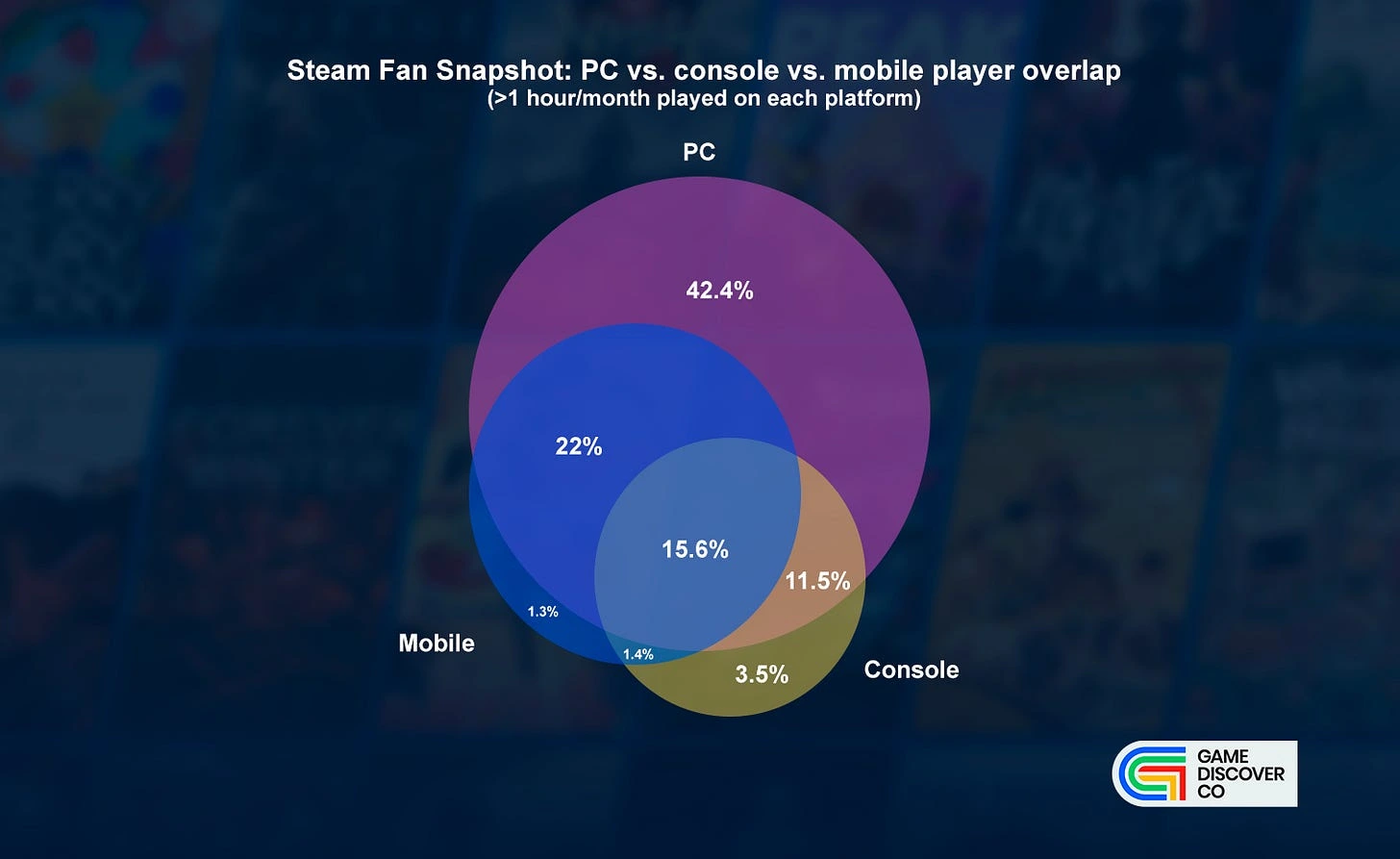
It is also worth weighing the hardware. Epic's tests were run on 13 Windows PCs, and three lower-performance machines were left out of the final average; on more modest computers, times tend to be longer and the difference between clients can even reverse. Even so, a lighter client reduces the friction for those who open the launcher several times a day — and that ties into the peaks in concurrent players on Steam. Native Linux, in turn, interests those who build machines to game outside Windows, a segment that also appeared in the survey according to which nearly half of Steam fans play only on the computer.
What cannot be honestly stated is that "one is faster than the other" in absolute terms. Each launcher wins in its own test, and the result changes with hardware, operating system and what is measured. The reasonable recommendation is the same one Epic itself made: download the Preview, install it alongside the current client and compare on your computer. More market and platform data is in our Games section.
The data in this article comes from the official announcement of the new Epic Games Launcher, from the notes of the October 13 Steam Client Update and the notes of the October 16 Steam Client Beta, plus the Inven Global report on the case.
Suggested and related articles

QUIET launches co-op horror demo on Steam and Epic
42.4% of Steam fans play only on PC, survey finds

Prinny Party: Going Overboard! — Demo Out Now on PS5, Switch and PC; Disgaea Party Game Launches in November

Football Manager 27 Gets 5-Day Free Trial

RF Online Next launches Nova server with growth boost