Astrae Oratio: 93% intend to play after global beta
Published on · Updated on
NC details Astrae Oratio global closed beta data: 93% intend to play at launch, 86.7% rated their first impression positively and 80% returned on day two.
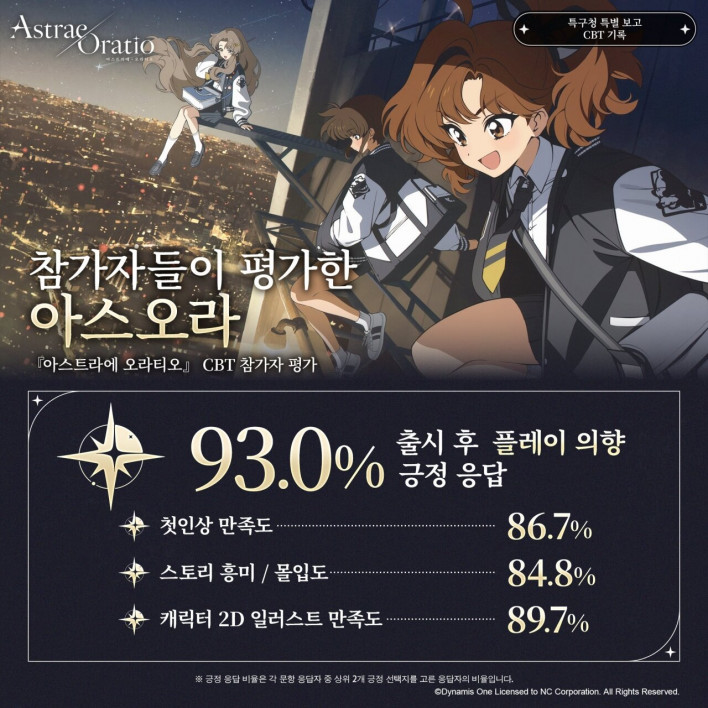
NC released an infographic on Thursday (22) detailing the global closed beta results for Astrae Oratio, a magic RPG developed by Dynamis One. The test ran for five days, from October 2 to 6, on iOS and Android, and drew players from several regions. According to the post-CBT survey, 93% of respondents intend to play the game after launch, 86.7% rated their first impression positively, and more than 80% praised the story and characters. The South Korean publisher will use the data to refine development ahead of the debut, scheduled for 2027.
The report combines two kinds of information. On one side is player opinion on narrative, art and combat. On the other is server telemetry: hours played, combat attempts, bosses defeated and return rates. Together, the indicators form the first global snapshot of a project NC is presenting as its main bet in the anime RPG market — a segment dominated by Chinese studios, where the company best known for the Lineage franchise still has to prove it can compete.
A reception above the norm for a closed beta
The survey numbers are NC's central argument. Stated intent to play after launch reached 93%, a figure that closed tests usually warrant treating with caution: people who sign up for a beta generally already show prior interest in the genre. Even so, paired with the positive first impression (86.7%) and the score for 2D illustrations (89.7%), it suggests the game turned curiosity into real willingness to keep playing.
The story also performed well, with 84.8% favorable responses on interest and immersion. That is a sensitive point for Astrae Oratio. The game leans into an urban-chronicle tone, with bureaucracy, everyday life and magic sharing the same space, rather than the epic battles against gods or empires that usually define the genre.
| Survey indicator | Result |
|---|---|
| Intent to play after launch | 93.0% |
| Positive first impression | 86.7% |
| Satisfaction with 2D character illustrations | 89.7% |
| Interest and immersion in the story | 84.8% |
For NC, the result works as validation before the company spends on a launch campaign. It did not disclose how many players took part in the beta, which prevents comparing the sample with similar tests. It also did not provide a margin of error or the survey methodology, details that usually accompany this kind of report. The percentages should therefore be read as a signal of trend, not as a rigorous statistical measurement.
Nearly 80,000 hours and 1.13 million combat entries
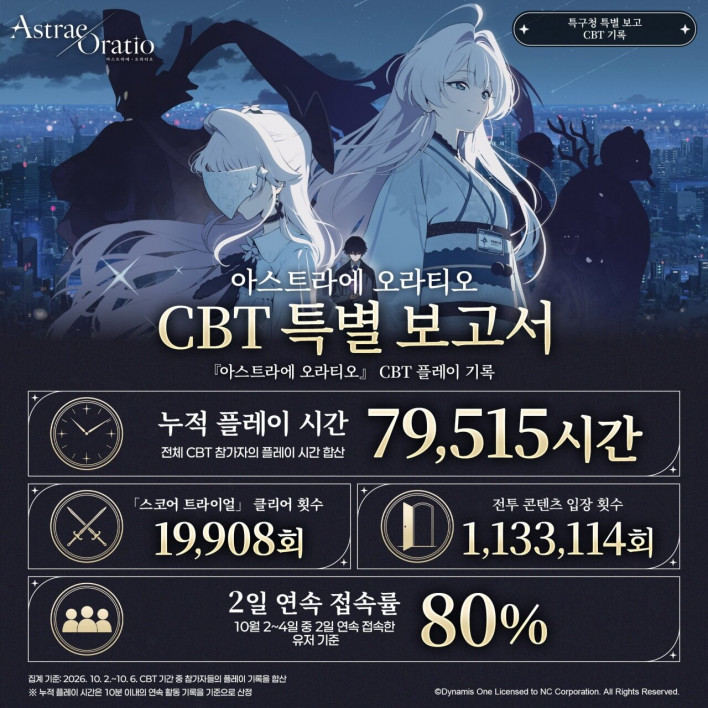
If the survey measures intent, usage data measures behavior. Over the five days, players logged 79,515 hours of play time — the equivalent of just over nine years of continuous matches. Combat content recorded 1,133,114 entries, and the Score Trial boss challenge was cleared 19,908 times.
The most relevant retention indicator is the second-day return: eight out of ten participants opened the game again the day after their first session. In free-to-play mobile games, day-2 retention is one of the metrics producers watch most closely, because it shows whether players found a reason to come back before spending any money.
| Usage metric | CBT total |
|---|---|
| Total play time | 79,515 hours |
| Entries into combat content | 1,133,114 |
| Score Trial clears | 19,908 |
| Players returning on day two | 80% |
The figures also help gauge the pressure on servers and balancing. One million combat entries in five days means an average of more than 200,000 attempts per day, spread across different difficulty levels. For a closed test, that is a volume that demands stable infrastructure and enough data to calibrate progression, economy and difficulty curve.
Score Trial: the Maniac 20 wall
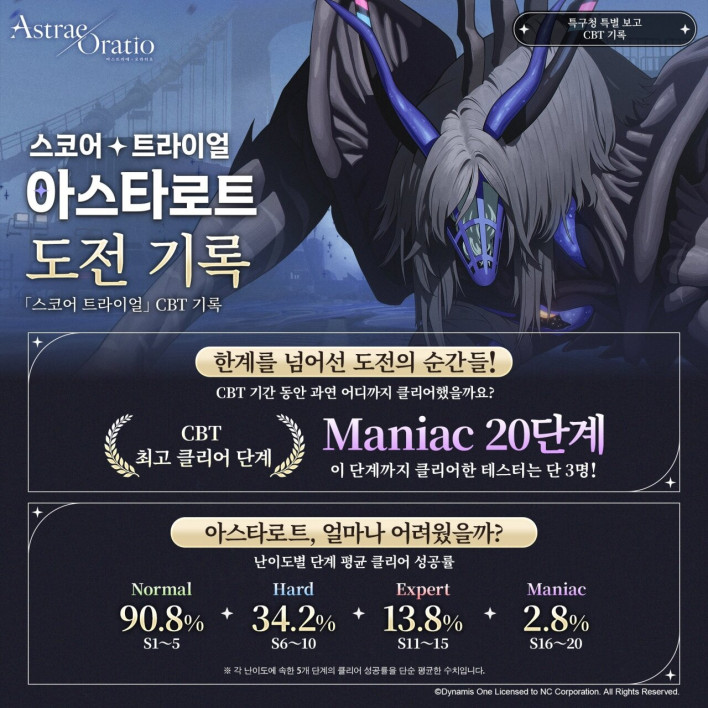
The infographic also breaks down performance in Score Trial, a battle in which players face the boss Astaroth under changing conditions and compete for points. Clear rates fall sharply as difficulty rises: 90.8% on Normal, 34.2% on Hard, 13.8% on Expert and just 2.8% on Maniac.
The highest tier, Maniac 20, was reached by three testers. The figure is at once proof that challenging content exists at the end of the curve and a warning about accessibility: if the goal is to keep most of the audience engaged, the team must ensure progression does not become a wall before launch.
| Difficulty | Stage range | Average clear rate |
|---|---|---|
| Normal | 1 to 5 | 90.8% |
| Hard | 6 to 10 | 34.2% |
| Expert | 11 to 15 | 13.8% |
| Maniac | 16 to 20 | 2.8% |
What the beta included
The test offered only part of the planned content. Players went through three main chapters — "Tokyo, Civil Servants and Wizards," "The Sparkling Days of the Wizards of Minato Ward" and "Shinjuku Ward: The Night of the Vanished Wizard and the Ghost Story Hunters" — plus two mini stories. Combat quests in Minato and Shinjuku were available across normal, hard, very hard and challenge difficulties.
The Simulation Room, a resource dungeon for character growth, and Free Time, an interaction mode that builds bonds with the cast, completed the experience. Cosmetics and voice lines were also available, suggesting NC wanted to test not only combat but the audience's emotional attachment to the characters — a central element in games that live off selling characters.
Tokyo, public offices and magic
Astrae Oratio is set in a version of Tokyo where magic and daily life coexist. Players take on the role of Shunin, a public official at the Special District Office, the agency responsible for overseeing the affairs of mages. The premise moves the anime RPG into public administration: instead of saving the world, the protagonist resolves conflicts, follows cases and meets characters while moving through the city.
The cast and setting were rolled out through 2026. In July, NC opened beta registrations; in September, it brought the first playable Astrae Oratio demo to Tokyo Game Show and confirmed a 2027 launch for iOS and Android, with a PC version to follow. The game is published by NC and developed by Dynamis One, a South Korean studio marked by a controversial earlier project and now trying to rebuild its reputation with a larger production.
"We're bringing the story, art and combat together into a cohesive gameplay experience, which we'll continue to expand through live service updates. Starting with the first playable demo at Tokyo Game Show, we hope you'll follow Astrae Oratio as it grows into an ongoing series, with new stories and characters introduced over time."
Colorful art and a female-led cast sit at the center of the messaging. The infographic highlights satisfaction with 2D illustrations precisely because NC treats that as a competitive edge. In a market where collectible characters sustain the revenue model, visual appeal is a condition for future conversion.
What changes before 2027
NC says it will incorporate the feedback and gameplay data gathered in the beta into development and service preparation. The company has not presented a detailed schedule, an exact release date, a monetization model or plans for further tests. There is also no confirmation of a simultaneous global launch or Portuguese localization.
The market, however, is watching closely. Astrae Oratio arrives as anime-style mobile RPGs consolidate, with strong competition and high user-acquisition costs. A beta with 93% intent to play and 80% second-day return is a useful calling card, but it does not guarantee commercial performance: long-term retention, monetization and the pace of updates will define the outcome.
For players outside Asia, what exists today is the promise of an anime RPG with an unusual urban setting, active turn-based combat and a focus on character-driven storytelling. Readers can follow the genre through the games and gaming sections of O Santuário Geek. It is also worth revisiting what has already been shown about the Rosa de Bunkyo, one of the game's core character groups.
Official details are available on the Astrae Oratio website and in NC's press release. The original report that served as the basis for this article was published by Inven Global.
Suggested and related articles
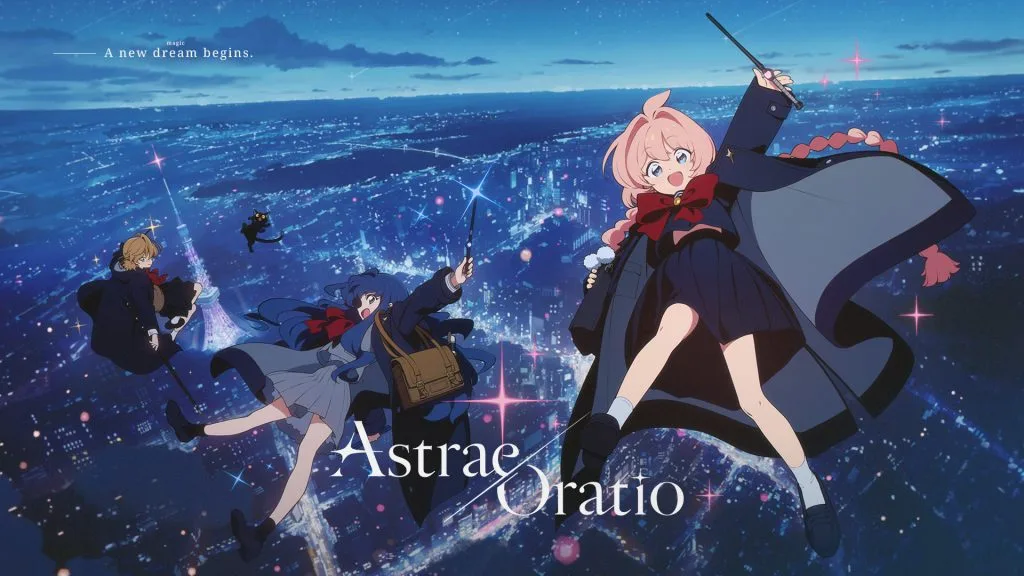
Astrae Oratio Reveals the 'Rose of Bunkyo': The Magical Vigilante Clan Protecting Tokyo from the Shadows
Crimson Desert DLC Charting the Unknown gets video and date

Blade & Soul NEO marks 2 years with Jackson Pizza collab

MIR4 launches Chuseok ‘Lunar Feast’ event: Lunar Training, Songpyeon Shop and exclusive rewards into October
Final Fantasy VII Revelation: What the Final Chapter Inherits and How It Expands with Highwind, FITS System and Combat Chocobo