How Japan protects anime copyright beyond its borders
Published on · Updated on
CODA, criminal cases and revenue cuts: Japan has built a network to protect anime abroad. Here is what it changes for fans and streaming services.

On November 9, 2026, at the Akasaka Palace in Tokyo, Japanese Prime Minister Sanae Takaichi met with To Lam, general secretary of Vietnam's Communist Party and the country's president, and called for tougher action against piracy of Japanese content — anime, films and dramas included. The account comes from Vietcetera, which covered the official visit. The request came with an uncomfortable number: 74.2% of respondents in Vietnam said they consume pirated audiovisual content, according to the annual survey by CODA, the Japanese body that coordinates protection of the country's content overseas.
The diplomatic pressure is only the visible part of a 24-year-old structure. Japan does not try to stop piracy with domestic laws alone: it funds monitoring, gathers evidence for foreign police, cuts off revenue to illegal sites and negotiates with governments. The stated goal is simple — to make sure the money an anime generates abroad reaches the people who made it, not clandestine networks that profit from advertising, subscriptions and user data. Understanding how the machine works helps explain why some titles disappear, why others arrive late and what changes for viewers.
The request that put piracy back on the agenda
To Lam was in Japan from November 8 to 11 on an official state visit. The schedule included meetings with the imperial family, the signing of ten cooperation documents and a joint statement on critical minerals, semiconductors and energy. The part that matters to the content business, however, does not appear in the official readouts: according to Vietcetera, Takaichi asked for firmer action against operators of pirate sites distributing Japanese works, with emphasis on anime.
The request did not come out of nowhere. On April 30, 2026, the Office of the United States Trade Representative (USTR) named Vietnam the only “Priority Foreign Country” in its Special 301 Report, the most severe category in the document, and described the country as having “the highest incidence of online piracy in the Asia-Pacific region.” Weeks later, on May 29, Washington opened a Section 301 trade investigation. Under pressure from both sides, Hanoi launched a nationwide intellectual property enforcement campaign.
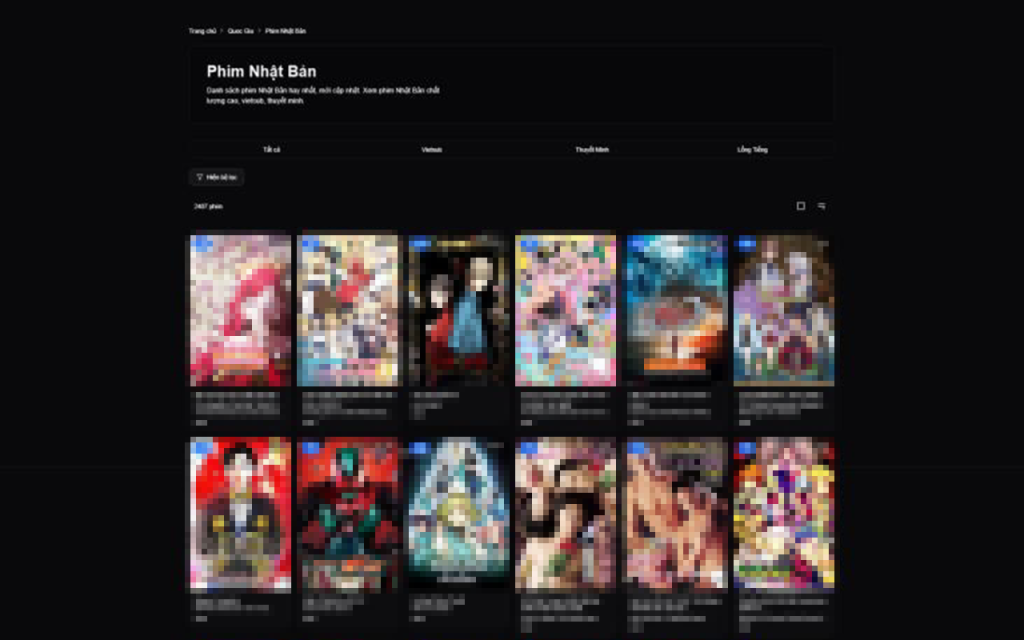
The first concrete result arrived in August. On August 1, 2026, the Economic Police Division of the Hanoi City Police announced criminal proceedings against three men: a 23-year-old from Dong Nai, identified as the operator of the website “Phim Nè” (phimne.live), and two 29-year-olds from Da Nang, who ran the app of the same name. According to CODA, the site launched in June 2025, gathered 1,090 registered members and more than 90,000 visits, and distributed about 2,400 works — including Japanese anime, films and dramas — with Vietnamese subtitles or dubbing, without authorization. The app charged a membership fee after 15 free minutes; between early 2025 and April 2026, it recorded 6,451 payments and about 415 million dong (roughly US$16,000).
The amount is modest by global piracy standards. The significance of the case is different: it was Vietnam's first criminal action over copyright infringement involving Japanese content, according to CODA itself.
“This criminal enforcement action is not only an important case demonstrating the effectiveness of protecting Japanese content in Vietnam — where such protection had previously been difficult to achieve — but also an important precedent that will significantly advance future rights enforcement.”
What CODA is and why it sits at the center
The Content Overseas Distribution Association (CODA) was established in 2002 at the call of Japan's Ministry of Economy, Trade and Industry (METI) and the Agency for Cultural Affairs. It brings together animation studios, publishers, broadcasters, record labels, distributors and game companies — in other words, nearly the entire chain that lives off Japanese intellectual property. Its official mission has two legs: promoting Japanese content overseas and fighting piracy.
In practice, the organization works as an intelligence and coordination hub. It keeps offices abroad — Beijing, Taipei and, since April 2026, a Vietnam Center in Ho Chi Minh City —, hires local investigators, documents infringement and brings cases to authorities. It also negotiates with governments and industry groups. Since 2005, it has carried out joint enforcement operations with the Motion Picture Association (MPA), which represents Netflix, Disney and other major studios; the memorandum of understanding between the two organizations, signed in 2014, was renewed for the sixth time on April 10, 2026.
In the Phim Nè case, CODA worked alongside law firms IP FORWARD and MNB Law. Studios TMS Entertainment and Toho confirmed ownership of the infringed works and supplied documents to the investigation. The operation was funded by a project commissioned by METI — a detail that shows how defending anime is also industrial policy.
The five tools used beyond Japan's borders
1. Takedowns and deindexing
The first step is always to try to get the work offline. CODA and rights holders send notices to hosting services, domain registrars and search engines requesting removal and deindexing. When a site changes address — a common tactic — the cycle starts again. In Japan, ABJ (Authorized Books of Japan), created by publishers and digital distributors, keeps its own tally: as of January 1, 2026, it had identified 881 manga piracy sites, 375 of them in English, 190 in Japanese and 85 in Vietnamese. In June 2025, those sites drew about 2.8 billion visits from 123 countries and regions.
2. Criminal action and police cooperation
CODA does not prosecute anyone: it gathers evidence and files complaints with local authorities, backed by law firms and partners such as the MPA. That is how it worked in Vietnam and also in the biggest manga case in recent years. On September 25, 2025, CODA's Beijing office filed a criminal complaint in China on behalf of Kadokawa, Kodansha, Shueisha, Shogakukan and Square Enix against the operator of BATO.TO. Shanghai police carried out searches on November 19, 2025; the suspect admitted running the network.
3. Cutting off revenue
Since 2014, CODA has also pursued so-called “indirect measures”: asking ad networks to stop serving ads on pirate sites, payment processors to close accounts and platforms to remove links. The logic is financial. Taking a site down can take days; cutting its cash flow often hurts more, because it prevents the operation from funding itself and reappearing under another domain.
4. Warnings, filtering and education
Partner security software displays warnings when users try to open a site listed as illegal. Local campaigns explain why legal subscriptions matter. In Japan, the ABJ mark works as a whitelist of authorized manga services — a way to point readers toward legitimate platforms instead of only punishing irregular access.
5. Technology and litigation
In 2025, the Japanese government tested an artificial intelligence system to detect pirated content. The pilot identified 1,168 posts on X, 1,935 manga site URLs and 1,564 anime site URLs, with accuracy rates of 83.6%, 94% and 89.3%, respectively, according to a government presentation at WIPO. Automation does not replace legal analysis, but it shortens the gap between discovery and takedown requests. In parallel, rights holders pursue civil damages suits — a slower route, but essential to building case law.
The Japanese law that reaches across borders — and what it cannot do
The domestic legal basis was tightened in 2020. The amendment to the Copyright Act, passed in June that year, created two fronts. The first, in force since October 1, 2020, criminalized the operation of “leech sites” — pages that aggregate links to illegal content — and equivalent apps, with penalties of up to five years in prison and a fine of up to 5 million yen. The second, in force since January 1, 2021, made downloading pirated works in general illegal, including manga, books and articles, not just music and video.
The rules have important filters. Downloading is only a crime when the user knows the material was uploaded illegally, when the work has a paid legal version and when the act is repeated or continuous. Short excerpts, parodies and situations that do not unfairly harm the rights holder are excluded. And there is a distinction that confuses many people: streaming a pirate site is not illegal in Japan; downloading, under certain conditions, is.
The most obvious limit is territorial. A site hosted abroad cannot be shut down by Tokyo. Japan has also never managed to approve administrative site blocking. In 2018, the government tried an emergency measure against Mangamura and two other sites; carriers warned that blocking would violate the secrecy of communications and the constitutional ban on censorship, and the legislative debate was shelved. To this day, blocking by carriers in the country exists in consolidated form only for child sexual abuse material, through voluntary industry action since 2011. In 2026, the topic returned — but because of data leaked in cyberattacks, not anime.
The practical result is that anime protection depends, far more than one might imagine, on international cooperation. Unable to block at scale, Japan bets on targeted takedowns, criminal cases abroad and diplomatic pressure — exactly what happened in Vietnam.

BATO.TO and Phim Nè: two portraits of the same network
The two most recent cases show opposite scales of the problem. BATO.TO was, according to CODA, the world's largest manga piracy site: it operated at least 60 domains, drew 350 million visits in May 2025 alone and accumulated about 7.2 billion hits over 37 months. The organization estimates the economic impact at around 770 billion yen. The network distributed Japanese, Chinese and Korean works translated into more than 50 languages. After the complaint and the searches in China, all 60 sites were shut down by January 19, 2026.
Phim Nè was small: 90,000 total visits, a handful of subscribers, less than US$20,000 in revenue. Its relevance is legal. The case grew out of a CODA investigation supported by newly tightened Vietnamese laws and created the first criminal precedent for Japanese content in the country. “This action is only the tip of the iceberg,” the organization said at the time. In October, seven men linked to HiAnime — which at one point topped Crunchyroll and Disney+ in traffic — were indicted in Vietnam, accused of moving US$12.85 million in advertising between 2019 and 2026.
What it means for fans and streaming services
The market explains the intensity of the dispute. According to the Association of Japanese Animations (AJA), the anime industry earned 4.45 trillion yen in 2025, up 15.8%; overseas markets accounted for 2.54 trillion yen, or 57.1% of the total. The government wants more: the target is 6 trillion yen in overseas anime sales by 2033, within a goal of 20 trillion yen for all Japanese content.
There is a distribution problem inside that growth. METI estimates that only 10% to 20% of revenue generated abroad returns to Japan, because the distribution layer — platforms, app stores, licensing — sits mostly with foreign companies. That is why the official strategy combines commercial expansion and anti-piracy work: without an attractive legal catalog, reasonable pricing and a short release window, audiences drift to free options.
For viewers, the effects show up in details. Pressure for licensing tends to expand the legal catalog and shorten the gap between a Japanese premiere and its arrival abroad — the simulcast model. It also pushes for more dubbing and subtitles in Portuguese, Spanish and other languages. On the other hand, fragmentation across platforms continues: the same studio can have titles on different services, and availability varies by country. To this day, there is no single global anime catalog.
The size of the losses helps explain the urgency. The survey commissioned by METI and published on January 26, 2026 estimated losses of 5.7 trillion yen from digital content piracy in 2025, nearly triple the 2.0 trillion yen of 2022. Adding counterfeit character goods, measured for the first time, the total reaches 10.4 trillion yen. A separate ABJ study puts the impact of free manga reading on illegal sites at 8.5 trillion yen a year.
“For media and creative industries, criminal enforcement changes the risk-return calculation: legitimate platforms no longer compete directly with zero-licensing-cost pirate services.”
Brazil is on that map. It was one of the six countries surveyed by CODA, alongside Japan, China, Vietnam, France and the United States, and has already seen joint operations against anime sites: in 2024, “Operation Anime 2” took down 16 pirate services, according to CODA. For Brazilian readers, the practical translation is familiar: when an anime does not arrive officially, the temptation of a clandestine site grows — and that is precisely the gap studios are trying to close with distribution deals.
| Segment | Overseas sales in 2024 | 2033 target |
|---|---|---|
| Games | ¥3.4tn | ¥12tn |
| Anime | ¥2.1tn | ¥6tn |
| Manga | ¥0.3tn | ¥1tn |
| Music | ¥0.1tn | ¥0.7tn |
| Live-action film and TV | ¥0.1tn | ¥0.5tn |
| Total | ¥6.1tn | ¥20tn |
Source: METI's Entertainment and Creative Industry Strategy 2026. Values in trillions of yen.
What to watch next
The offensive is likely to continue. On August 20, 2026, METI published the “Entertainment and Creative Industry Strategy 2026,” a five-year plan that organizes subsidies, financing and targets for the sector. The ministry's content budget jumped from 10.2 billion to 35.6 billion yen in fiscal 2026, and the total across ministries went from 25.2 billion to 58.9 billion yen. Among the indicators is a goal to raise the value of piracy “suppressed” from 0.7 trillion to 4 trillion yen a year.
Vietnam has also changed its legislation. The Intellectual Property Law 131/2025 took effect on April 1, 2026, with clearer liability rules for online platforms. A decree on administrative sanctions came into force in February, and another, issued in 2026, set requirements for using works to train artificial intelligence, including an opt-out right for rights holders. The Section 301 investigation is still underway, and the country is preparing to host APEC in 2027 — which tends to keep enforcement in the spotlight.
For fans, the consequence is ambiguous. More enforcement means fewer easy illegal options, but it does not by itself guarantee cheaper, faster access. The promise Japan needs to keep is the other half of the equation: turning global demand for anime into a legal catalog available at the right price and in the right language. Until that math works out, piracy will remain the most visible symptom of a market that is growing — and has not yet learned to share the profit with those far from Tokyo.
Readers who want to follow the topic can start with the portal's anime archive and with changes in the Crunchyroll catalog, a thermometer of international licensing. To understand the chain that funds all of this, it is worth seeing how Japanese studios are raising money, as in AniBiz's round with TBS, Toei and TV Tokyo. And for manga readers, the complete guide to the genre helps separate official editions from pirated material.