GTA 6 on PS5 vs PS5 Pro: why 30fps holds better
Published on · Updated on
In heavy explosions, GTA 6 drops to 23fps on base PS5 while the PS5 Pro barely leaves 30fps; see what the hardware explains and why the cap stays.
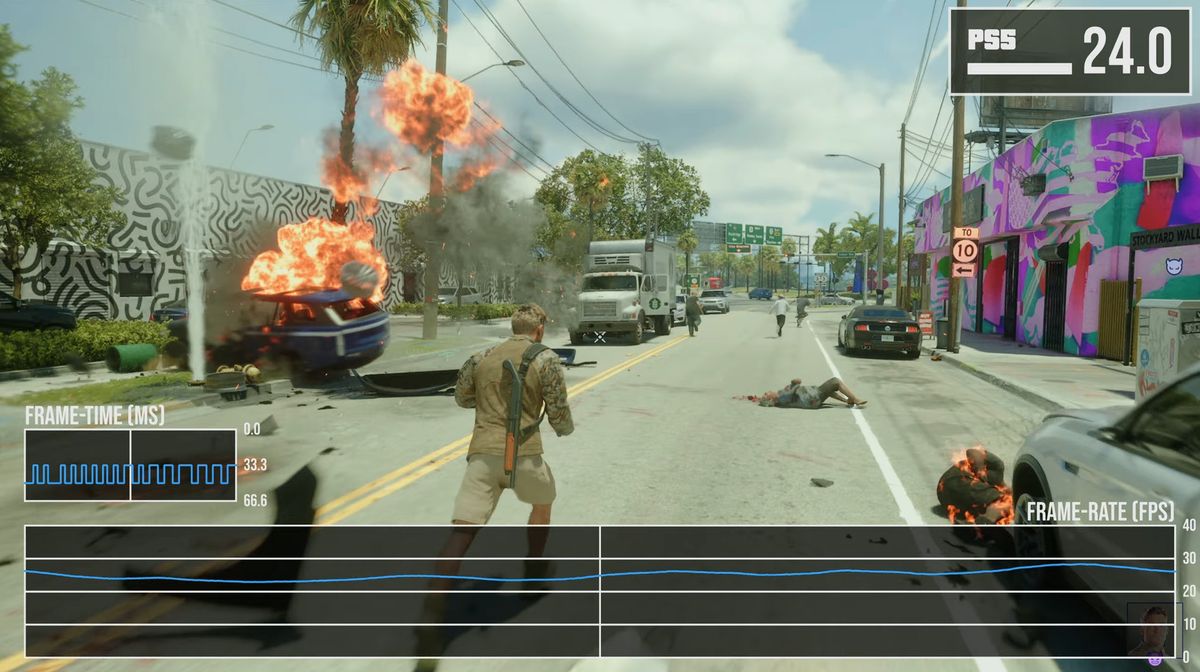
Grand Theft Auto VI launched on November 19, 2026 with a fixed 30 frames-per-second target across every console, and according to Digital Foundry's technical analysis the base PlayStation 5 is the model that struggles most to hit it. In heavy action scenes, with cars exploding in sequence, the game measured by the British team dropped to 23fps and stayed below the target while the destruction remained on screen. On PS5 Pro, the same kind of test only dipped to 24fps for an instant before recovering.
That one-frame gap at the worst moment, however, hides a bigger difference in consistency: the premium console spends most of its time locked to 30fps with steady frame pacing, while the original model fluctuates more often. In this guide, The Geek Sanctuary compares the two versions, explains what each console's hardware actually does and shows why the 30fps cap is unlikely to change anytime soon.
What Digital Foundry measured on each console
The analysis was published on November 18, 2026, the eve of the worldwide launch, and collects captures from all four console platforms: PS5, PS5 Pro, Xbox Series X and Xbox Series S. This article focuses on Sony's internal duel — the model most players already own against the premium version sold as the most powerful hardware of the generation.
On base PS5, Digital Foundry recorded small dips during normal play, described by the team as "really very minor" but noticeable enough to spoil a constant sense of smoothness. The picture changes when the player causes mass destruction. Using a grenade launcher to blow up cars on a Vice City avenue, the frame rate fell to 23fps and stayed below 30fps continuously — not a half-second stutter, but a sustained period that only ended when the area was left behind or the character died.
The caveat the analysts themselves make matters: this is the worst-case scenario, not the average. GTA VI's average performance on PS5 stays close to 30fps. Players who run missions, drive around the city and explore the map without turning every block into a war zone will tend to find a stable experience. Those who like to test the limits of the physics engine will not.
"If you're the kind of GTA player who just wants to run around blowing things up, you might get performance like this." — Digital Foundry, technical analysis of November 18, 2026
On PS5 Pro, the situation is different. After more than 50 hours of play, the analysts did not record a single dip during normal gameplay. Frame pacing is described as perfect, cutscenes run without hitches, and the console only misses its target in the same extreme explosion scenario, when the rate briefly slips to 24fps before returning to 30.
"The PS5 Pro is the best way to play this game by far." — Digital Foundry, technical analysis of November 18, 2026
Why the PS5 drops to 23fps in explosion scenes
At 30fps, each frame has roughly 33.3 milliseconds to be assembled, from physics calculations to the signal reaching the TV. Any effect that blows that budget in a single frame shows up as a stutter; if the overrun repeats for several seconds, the rate simply does not return to target until the scene changes.
Explosions are expensive for several reasons at once. There are transparent particles — smoke, sparks, fire trails —, debris with its own physics, dynamic lights and ray-traced reflections being recalculated in the middle of the chaos. The more screen area those layers cover, the greater the pressure on the GPU. It is no coincidence that the dips measured by Digital Foundry last as long as the destroyed scene stays visible: the cost follows what is on screen.
The base PS5 has a GPU with 36 RDNA 2 compute units capable of 10.28 TFLOPS. That is enough power to sustain 1440p at 30fps most of the time in a game the size of GTA VI, but not enough headroom to double the load of transparency and lighting effects in a single block. When the scene demands more than the chip can deliver in 33 milliseconds, the rate falls — and it falls consistently, because the scene stays heavy as long as the debris and fire are there.
There is also the matter of frame pacing, the rhythm at which frames reach the screen. When the rate oscillates between 27 and 30fps, the interval between one frame and the next varies, and the perception of smoothness drops further than the isolated number suggests. That is precisely where the PS5 Pro sets itself apart: even when it misses the target for an instant, the cadence stays regular, and the eye registers a short stumble instead of a drawn-out drag.
What makes the PS5 Pro different inside
The PS5 Pro is not a next-generation console. It keeps the same CPU architecture as the PS5, with eight Zen 2 cores, and bets on three fronts: more graphics units, more memory bandwidth and a dedicated AI upscaler. It is a recipe designed to improve image quality and stability, not to double the frame rate.
| Component | PS5 | PS5 Pro |
|---|---|---|
| CPU | 8 Zen 2 cores at 3.5 GHz | 8 Zen 2 cores, high-frequency mode up to 3.85 GHz |
| GPU | 36 RDNA 2 CUs, 10.28 TFLOPS | 67 CUs, 16.7 TFLOPS |
| Memory | 16 GB GDDR6, 448 GB/s | 16 GB GDDR6 + 2 GB DDR5, 576 GB/s |
| Upscaling in GTA 6 | Rockstar's TAA | PSSR |
| Internal resolution in GTA 6 | 1440p, 4K output | 1440p, 4K output |
| Ray-traced shadows in GTA 6 | No | Yes, exclusive to the model |
The graphical leap is real: 67 compute units against 36, with almost 60% more raw floating-point power. But that does not automatically translate into extra frames, because the game is bound to a fixed target and because part of the gain is spent on effects the PS5 cannot run — ray-traced shadows are the clearest example. The Pro uses that headroom to hold the rate more firmly and to reconstruct the image with higher quality, not to raise the frequency.
PSSR: the difference that shows up more in the image than in frame rate
One curious detail of the analysis is that the PS5 and the PS5 Pro render GTA VI at the same internal resolution, 1440p. The difference is in the path to the screen. On the base model, Rockstar applies its own temporal anti-aliasing (TAA), a simpler solution that delivers a 4K-looking image through upscaling. On the Pro, PSSR steps in, Sony's machine-learning upscaler, which reconstructs fine detail and, according to Digital Foundry, produces a result that "convincingly passes for native 4K".
In practice, that means base PS5 owners see softer edges, aliasing on fences and railings and some loss of definition in motion. These are differences that do not show up in a still capture but become obvious when the camera turns on a busy avenue. And there is the item only the Pro offers: ray-traced shadows. On the other consoles, GTA VI keeps ray-traced global illumination and reflections, but shadows follow the traditional method, with harder edges and without the natural softness that occurs when the light source is large.
Why there is no 60fps mode
The question that has dominated forums since the announcement has an unglamorous technical answer: doubling the frame rate means halving the processing time for each frame, from 33.3 to 16.6 milliseconds. In a game that simulates traffic, pedestrians, vehicle physics and an entire city in motion, the component that usually blows that budget is the CPU — and the PS5 Pro's CPU is practically the same as the PS5's.
That is why the premium console, even with almost twice the graphics power, does not turn GTA VI into a 60fps game. It reduces how often the frame rate drops and improves the image, but it does not change the ceiling. Rockstar confirmed the 30fps target on every platform and had not announced any performance mode by launch. The decision is consistent with the scale of the project: the studio prioritised scene density, lighting and stability over extra smoothness.

Digital Foundry itself summed up the result as "both acceptable yet a little disappointing" — while saying it was willing to forgive the limit Rockstar imposed given what the game puts on screen. The team called GTA VI "the single most visually striking game of the generation", which helps explain why the frame-rate conversation did not hurt its critical reception.
Is it worth switching consoles because of GTA 6?
For anyone who already owns a base PS5, the answer is no — at least not expecting 60fps. The game runs well on the original machine most of the time, and the dips appear in specific situations: chained explosions, chases with many vehicles on screen and scenes where destruction piles up. Players working through the story without causing chaos are unlikely to be bothered.
For those buying a console now, the maths changes. The PS5 Pro delivers the same internal resolution with far better reconstruction, ray-traced shadows and a frame rate that almost never leaves 30fps. It is the best console version of GTA VI, as Digital Foundry itself wrote. But it is an improvement in consistency and image quality, not in smoothness: nobody should buy the premium model expecting a 60fps mode that does not exist.
The PS5 versus Xbox Series X comparison already showed that the gap between the two main platforms is small in heavy scenes, and the PS5 Pro versus Series S duel laid bare the distance between the hardware extremes. GTA VI is at once a game that runs on every platform and a test of expectations: the 30fps target is the same for everyone, and what changes is how often each console manages to hit it.
What could still change
Rockstar has a history of post-launch adjustments, and a patch could soften the harshest dips on base PS5 without touching the 30fps ceiling. So far, however, there is no promise of that, nor any sign of a performance mode in development. Digital Foundry is expected to revisit the game after the first updates, and any relevant change tends to show up first in technical press measurements.
There is also no announced PC version, which keeps the comparison limited to consoles for now. For players in the middle of the decision, the summary is straightforward: the PS5 delivers GTA VI as it was designed, with predictable stumbles in the most chaotic scenes; the PS5 Pro delivers the same experience with far more stability and an image that convincingly disguises the native resolution. The 30fps target, that stays the same on both — and it should remain so.
To follow the technical fallout from the launch, see our breakdown of real bugs and frame drops on day one and the explainer on why there is no performance mode. The Digital Foundry analysis cited in this article was originally published on November 18, 2026 and reported by AltChar; official game details are on the Rockstar Games website.
Suggested and related articles
GTA 6 on PS5 vs Xbox Series X: which runs better?

GTA 6 on Twitch: what the 3.3 million viewers really mean
GTA 6: what to do after Building a Life mission
GTA 6 on PS5 Pro vs Series S: what really changes
GTA 6 launch: real bugs, FPS drops and what to know